
Summer is when the White Mountains show off. The trails are dry, the days are long, and the high ridges are cleaner and more dramatic than at any other point in the year. If you are based out of Bretton Woods, North Conway, Franconia, or anywhere along the Route 302 corridor, you have access to some of the best summer hiking in the White Mountains of New Hampshire within 45 minutes of your front door.
This guide organizes the best summer hikes by difficulty, with verified trail data, practical logistics, and what to actually expect on the trail. Whether you are planning three days of serious ridge walking or a single morning hike with a dog, the information below is drawn from BWV’s own trail experience, the AMC White Mountain Guide, and AllTrails data confirmed against current sources.
Trail Quick Reference
| Trail | Distance | Elevation Gain | Difficulty | Dog-Friendly |
| Lower Ammonoosuc Falls | 1.6 mi RT | Minimal | Easy | Yes |
| Diana’s Baths | 1.1 mi RT | Minimal | Easy | Yes |
| Artist’s Bluff + Bald Mtn Loop | 1.7 mi loop | ~450 ft | Easy-Moderate | Yes |
| Mount Willard | 3.2 mi RT | ~900 ft | Moderate | Yes |
| Arethusa Falls | 2.6 mi RT | ~800 ft | Moderate | Yes |
| Zealand Falls Trail | 5.4 mi RT | ~700 ft | Moderate | Yes |
| Franconia Ridge Loop | 8.9 mi loop | ~3,900 ft | Challenging | Yes, on leash |
| Mount Washington via Tuckerman | 8.4 mi RT | ~4,200 ft | Challenging | Below Hermit Lake |
| Sugarloaf Trails (Middle) | 2.6 mi RT | ~1,000 ft | Moderate-Hard | Yes |
| Sugarloaf Trails (North) | 3.4 mi RT | ~1,000 ft | Moderate-Hard | Yes |
Why Summer Is the Best Season for White Mountains Hiking
Late June through early September hits a rare sweet spot for hiking in the Whites. The mud season that plagues lower trails through May is long gone. Above treeline, the alpine zone is fully exposed and dry by mid-June. Blackfly season, which runs roughly mid-May to mid-June, is over. Days are long enough that a 7:00 AM start gives you nine or ten hours of daylight before you need to be thinking about descent.
The tradeoff is crowds. The most popular trails, particularly Mount Willard, Franconia Ridge, and the Flume Gorge, fill fast on summer weekends. Parking at Lafayette Place Campground for Franconia Ridge can be full before 9:00 AM on a Saturday in July. The fix is simple: start early. A 6:30 to 7:00 AM start on any trail in the White Mountains puts you ahead of the crowd, gives you the best light for photography, and typically means cooler temperatures on the exposed upper sections.
Worth knowing about summer hiking in the White Mountains specifically: even on a warm July day, summit temperatures can drop into the 40s Fahrenheit with wind. The summit of Mount Washington averages 35°F in July with winds that regularly exceed 40 mph. Even on trails that do not reach the summit, packing a light insulating layer and a rain jacket is not optional; it is standard practice.
White Mountain National Forest charges a $5-per-day recreation fee at most trailhead parking areas. The America the Beautiful Annual Pass ($80) covers the fee for a full calendar year and pays for itself within a few trips. Purchase it before you arrive. Most trailheads also accept the fee digitally at self-pay stations.
EASY SUMMER HIKES: BIG VIEWS, NO SUMMIT REQUIRED
Lower Ammonoosuc Falls
Distance: 1.6 miles out-and-back | Elevation gain: Minimal | Dog-friendly: Yes Best for: First-day warm-ups, families with young kids, evening walks
This is the most accessible easy summer hike from the Bretton Woods area and a reliable first day on the trail for any group. The trailhead is on Base Road off Route 302 in Twin Mountain, roughly ten minutes from most vacation homes in the Bretton Woods corridor. The path is mostly flat through hardwood forest along the Ammonoosuc River, ending at a set of powerful low-angle cascades. When water levels are safe, this is a popular swimming spot. The full round trip takes under an hour for most hikers.
Diana’s Baths
Distance: 1.1 miles out-and-back | Elevation gain: Minimal | Dog-friendly: Yes Best for: Families, all ages, anyone who wants waterfall access with minimal effort
Diana’s Baths, located off West Side Road in Bartlett near North Conway, follows Lucy Brook through mixed forest to a series of cascading rock pools and waterfalls fed from Big Attitash Mountain. The falls measure roughly 75 feet in total height spread across multiple tiers of smooth granite. The pools are shallow enough for safe wading in summer. This is one of the most-visited easy summer hikes in the White Mountains for good reason: it works for every age and ability level, and the payoff arrives quickly. Arrive by 9:00 AM to find a parking spot at the small lot on West Side Road. For families planning a full day around family hiking trails in the White Mountains NH, the White Mountains family activities guide covers both on-trail and off-trail options by age group.
Artist’s Bluff and Bald Mountain Loop
Distance: 1.7 miles loop | Elevation gain: ~450 ft | Dog-friendly: Yes Best for: Short summit payoff, photographers, guests staying in Franconia
One of the most overlooked short hikes in Franconia Notch. The trailhead is at Echo Lake off Exit 34C on I-93, directly above Echo Lake beach. The loop delivers two distinct summit experiences: the open ledge of Bald Mountain followed by the exposed rock of Artist’s Bluff, with views down the length of Franconia Notch and Echo Lake directly below. The section between the two summits requires some scrambling over exposed rock, which makes it feel more substantial than the mileage suggests. The views from Artist’s Bluff are among the most photographed in the White Mountains. After the hike, the beach at Echo Lake is directly below. Guests new to White Mountains trails may also want to review the beginner hiking guide for New Hampshire before selecting a route.
MODERATE HIKES: THE WHITE MOUNTAINS CORE EXPERIENCE
Mount Willard
Distance: 3.2 miles out-and-back | Elevation gain: ~900 ft | Dog-friendly: Yes Best for: Best effort-to-reward ratio in the region; first serious White Mountains hike
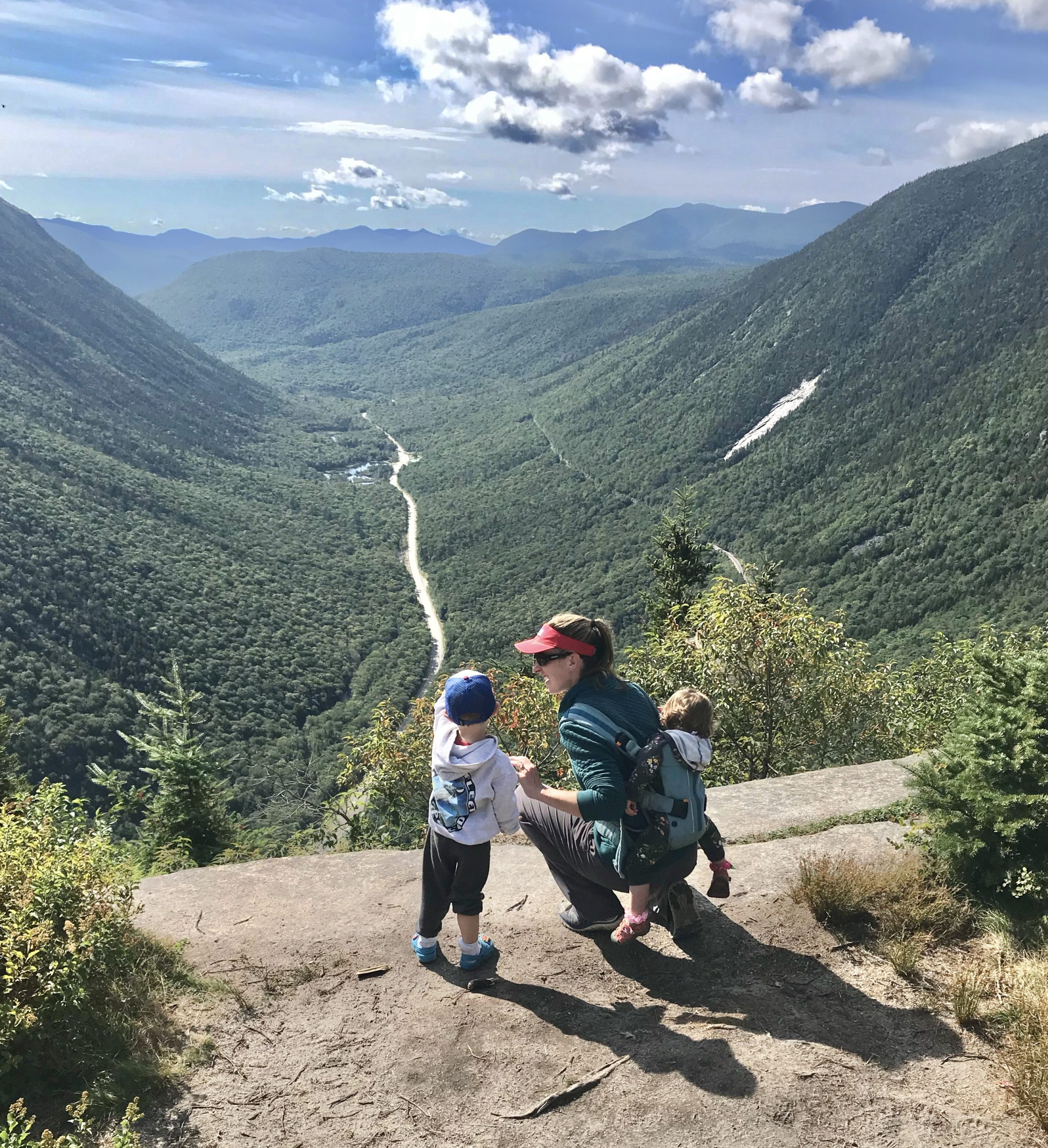
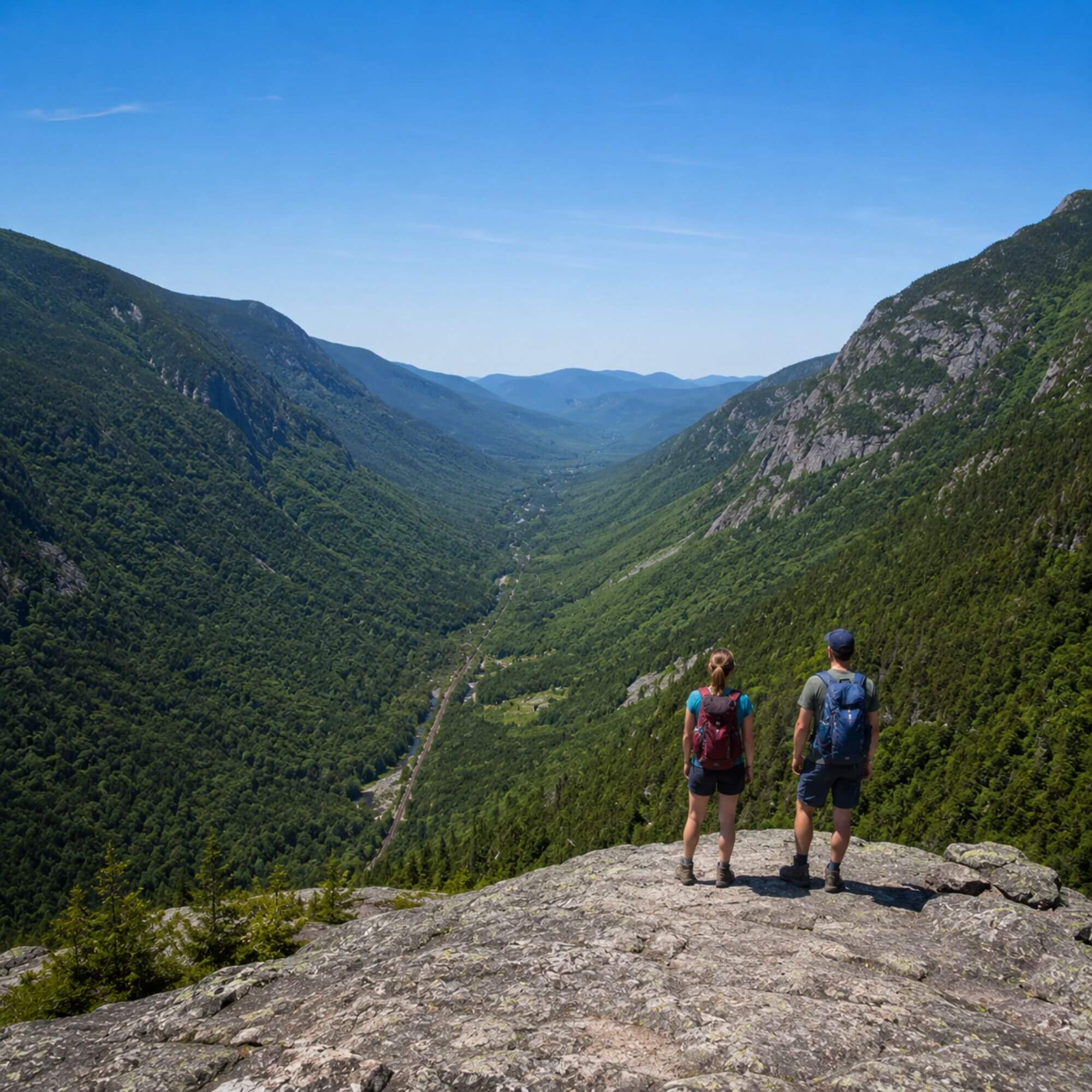
Mount Willard is consistently described as the best effort-to-reward ratio of any hike in the White Mountains, and the description holds up. The trail starts from the Crawford Depot trailhead on Route 302, follows a steady but never brutal grade through forest, and delivers a wide-open ledge at the top with a straight-down panoramic view of Crawford Notch. The Southern Presidentials fill the background. On a clear summer day, the view is one of the signature photographs of the entire region.
The trail is well-maintained and clearly marked. Most hikers complete the round trip in two to three hours. The trailhead parking fills fast on summer weekends, so a 7:00 AM start is recommended for July visits.
Arethusa Falls
Distance: 2.6 miles out-and-back | Elevation gain: ~800 ft | Dog-friendly: Yes Best for: Waterfall chasers; best single waterfall hike in the state
Arethusa Falls, in Crawford Notch State Park, is the tallest waterfall in New Hampshire, dropping roughly 200 feet. The trail from the trailhead on Route 302 is moderate and well-marked, gaining elevation steadily through forest before arriving at the base of the falls. In July, the falls run with less force than during spring snowmelt but remain impressive. The hike takes most people 90 minutes to two hours round trip.
For a longer version, the trail continues from Arethusa Falls to Ripley Falls, a shorter but still dramatic cascade, and can be looped back via Frankenstein Cliff Trail for views over Crawford Notch. That extended option adds roughly two miles and turns the day from a quick out-and-back into a full morning in the woods. The hiking and waterfalls guide groups the best waterfall hikes in the region together with access notes for each one.
Zealand Falls Trail
Distance: 5.4 miles to Zealand Falls Hut, out-and-back | Elevation gain: ~700 ft | Dog-friendly: Yes Best for: Families, dog owners, hikers who want a long flat walk with a destination
The Zealand Trail starts at the Zealand Recreation Area on Route 302, midway between Twin Mountain and Bretton Woods. The first several miles are nearly flat, wandering through woodland and past beaver ponds before the trail steepens toward a small but scenic waterfall adjacent to the AMC’s Zealand Falls Hut. The hut is worth the trip for anyone interested in the AMC hut system: it sits at a dramatic viewpoint and serves meals during summer operating season. Plan to spend some time at the hut before the return leg. The full round trip takes three to five hours for most hikers.
Franconia Ridge Loop via Falling Waters and Greenleaf Trails
Distance: 8.9 miles loop | Elevation gain: ~3,900 ft | Dog-friendly: Yes, on leash Best for: Experienced hikers; the defining White Mountains full-day hike
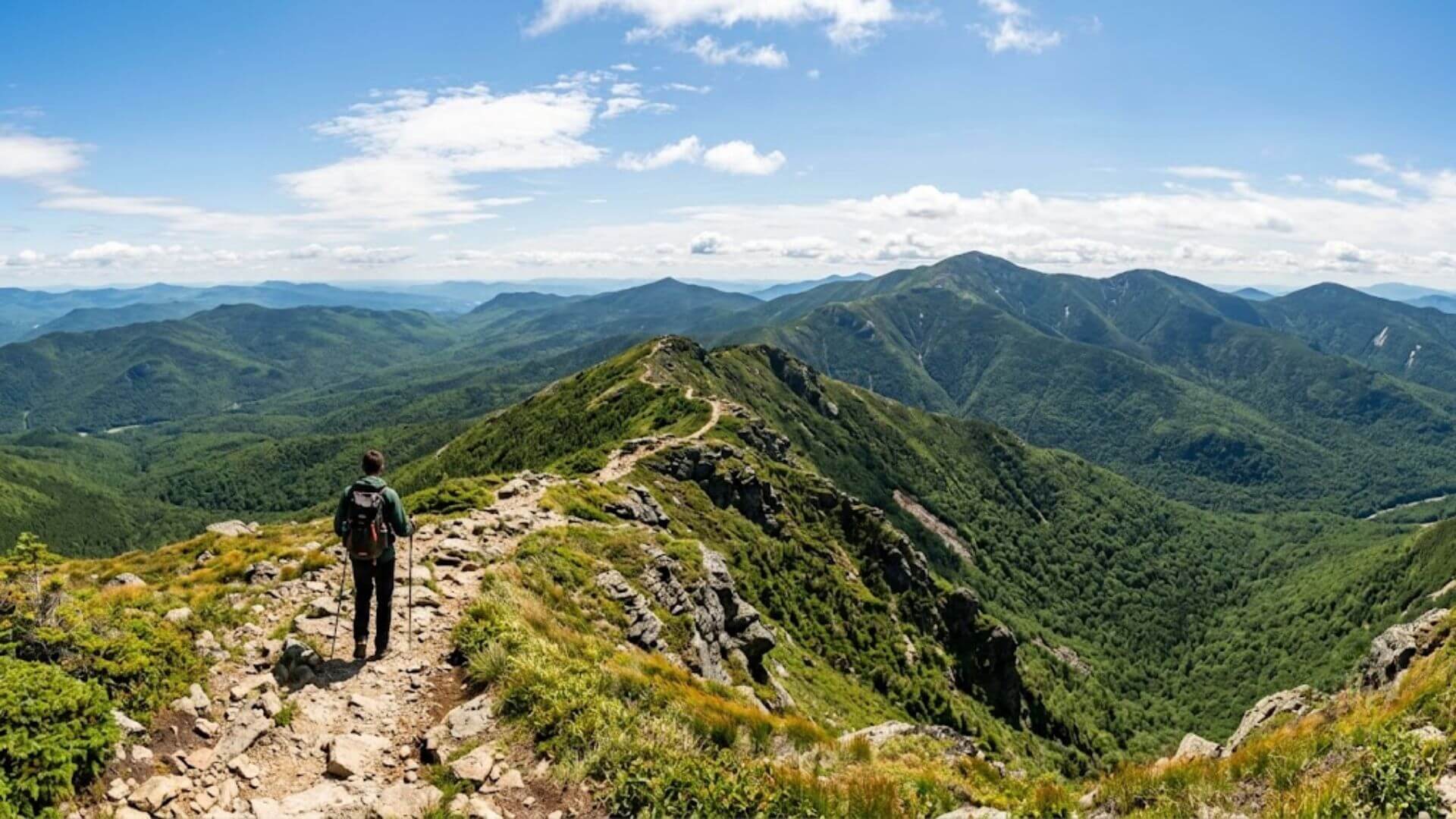
This is the hike that defines the White Mountains for most serious hikers. The standard approach ascends via the Falling Waters Trail, passing Cloudland Falls (one of the most dramatic waterfalls in the region), gaining the ridge at Little Haystack Mountain, and then traversing 1.7 miles of open, above-treeline ridge to Mount Lincoln and Mount Lafayette before descending via the Greenleaf Trail to Greenleaf Hut and back to the trailhead. Two 4,000-footers, nearly two miles of above-treeline walking, and waterfall views on the ascent.
The trailhead is at Lafayette Place Campground on I-93 in Franconia Notch. Parking fills by mid-morning on summer weekends without exception. Arrive before 7:00 AM or plan a weekday. Allow six to eight hours. The above-treeline ridge section is fully exposed, and afternoon thunderstorms are common in July. Check the forecast before you leave and plan your summit time for late morning rather than midday.
CHALLENGING HIKES: FOR EXPERIENCED HIKERS AND 4,000-FOOTER PURSUITS
Mount Washington via Tuckerman Ravine Trail
Distance: 8.4 miles out-and-back | Elevation gain: ~4,200 ft | Dog-friendly: Yes, below Hermit Lake Best for: The summit of the Northeast; serious full-day commitment
Mount Washington at 6,288 feet is the highest peak in the northeastern United States. The Tuckerman Ravine Trail, starting from the Pinkham Notch Visitor Center on Route 16 in Gorham, is the most popular hiking route to the summit and one of the best-maintained in the region. The trail passes through boreal forest before entering the dramatic headwall of Tuckerman Ravine, a glacially carved bowl that holds snow into late spring and frames one of the most striking alpine landscapes in the region.
The final 1.5 miles above the ravine are fully exposed alpine terrain, marked by cairns. Summit weather is notoriously severe: even in July, temperatures average around 35°F and wind is a near-constant presence. The Mount Washington Observatory records and publishes daily summit weather forecasts, which every hiker planning to summit should check the morning of the trip. This hike requires a full day, solid footwear, layers, and conditions awareness. Do not underestimate it based on mileage alone.
Sugarloaf Trails (Middle and North Sugarloaf)
Distance: 2.6 miles to Middle Sugarloaf, 3.4 miles to North Sugarloaf | Elevation gain: ~1,000 ft | Dog-friendly: Yes Best for: Summit views close to Bretton Woods without a full-day commitment
The Sugarloaf Trails leave from a trailhead on Zealand Road off Route 302 in Twin Mountain, very close to most Bretton Woods vacation homes. They offer summit views disproportionate to their difficulty. Middle Sugarloaf at 2.6 miles round trip rewards with wide views of the Twin Mountain valley and the Presidentials. North Sugarloaf extends the experience with additional panoramas to the north and east. These are among the best close-to-Bretton-Woods hikes for guests who want a half-day summit without committing to a full-day climb.
SUMMER HIKING LOGISTICS: WHAT TO KNOW BEFORE YOU GO
Trailhead fees. White Mountain National Forest charges a $5 daily recreation fee at most trailhead parking areas. The America the Beautiful Pass ($80 annually) covers this and all federal recreation areas for a full year. Display it on your dashboard. It pays for itself within two or three trips.
HikeSafe card. New Hampshire Fish and Game offers a voluntary HikeSafe card for $35 per person or $50 per family annually. It does not limit rescues but covers your cost if NH Fish and Game responds to your search and rescue call. Worth getting before a week of hiking in the Whites.
Weather. Mountain weather in the White Mountains changes rapidly. The Mount Washington Observatory posts a summit forecast daily at mountwashington.org. Even for trails that do not reach the summit, afternoon thunderstorms in July are common enough that morning starts are the safer and more pleasant approach.
Dogs. Most White Mountain trails allow leashed dogs. Diana’s Baths, Lower Ammonoosuc Falls, Mount Willard, the Sugarloaf Trails, and the Zealand Falls Trail are all dog-friendly in summer. Franconia Ridge and Tuckerman Ravine allow dogs on leash below certain elevations; check AMC trail notes for current guidance. Pets are not allowed on the Echo Lake beach at Franconia Notch State Park. The dog-friendly White Mountains activities guide and the pet-friendly hiking trails guide for Bretton Woods both cover the full network of trails and off-trail options for guests traveling with dogs.
Ten essentials. The AMC recommends carrying the ten hiking essentials on any White Mountains trail: map, compass, insulation layer, rain layer, headlamp, first aid, fire starter, repair tools, sun protection, water, and food. Even on a two-hour hike, the insulation layer and rain jacket belong in the pack. For a full summer packing checklist, the White Mountains summer gear guide covers trail-specific kit alongside everything else you need for a week in the mountains.
FIND YOUR PERFECT HIKING BASE IN THE WHITE MOUNTAINS
Where you stay shapes how much driving you do between the vacation home and the trailhead. For guests who want to cover multiple hiking areas across a stay, the central Bretton Woods and Twin Mountain corridor is the best base. It puts you 15 minutes from the Zealand and Sugarloaf trailheads, 20 minutes from Crawford Notch and Mount Willard, 35 minutes from Franconia Notch, and 45 minutes from Pinkham Notch and Tuckerman Ravine.
Guests focused on Franconia Ridge and the Cannon Mountain area will find better positioning in vacation homes in the Franconia area. Guests focused on North Conway-area trails, including Diana’s Baths and the Kancamagus Highway, are best based in North Conway vacation rentals, which is the highest-traffic location page on the site for good reason: the town sits at the intersection of four major hiking corridors.
The White Mountains summer activities page maps out the full range of what is open June through August beyond the trails. The NH-Hikes guide covers family trails across the full region with trail-by-trail details. For a full day-by-day framework that mixes hiking with other summer activities, the 3-day summer itinerary and the 5-day summer itinerary both include specific trail suggestions paired with afternoon plans for each day.
Bretton Woods Vacations manages 125-plus properties across the region with options for solo travelers, couples, groups, and families with pets. Properties come with full kitchens for packing trail lunches, outdoor spaces for evening decompression, and a digital guidebook with local recommendations. The concierge team is available 24 hours a day throughout your stay and can help with activity planning, restaurant reservations, and trail conditions. Browse vacation homes by location and group size to find the right property for a hiking-focused week.
FREQUENTLY ASKED QUESTIONS
What are the best summer hiking trails in the White Mountains NH?
For views with minimal effort: Mount Willard (3.2 miles, moderate, ~900 ft gain) and Artist’s Bluff (1.7-mile loop, easy-moderate). For a full-day challenge: the Franconia Ridge Loop (8.9 miles, ~3,900 ft gain). For waterfall hiking: Arethusa Falls (2.6 miles, moderate) and Diana’s Baths (1.1 miles, easy). For hikers based in Bretton Woods: Lower Ammonoosuc Falls and the Sugarloaf Trails are both within 15 minutes of the main property cluster.
Is July a good time to hike in the White Mountains?
July is one of the best months for hiking in the White Mountains. Trails are dry, blackfly season is over, days are long, and all trails are fully open. The tradeoff is that popular trailhead parking fills early on weekends. A 6:30 to 7:00 AM start solves most parking and crowd issues. Expect summit temperatures in the 40s Fahrenheit on exposed ridges even on warm valley days.
Do I need a pass to hike in White Mountain National Forest?
Most trailhead parking areas in White Mountain National Forest require a $5 daily recreation fee or an America the Beautiful Annual Pass ($80). The fee applies at USFS-maintained parking areas; it does not apply at state park trailheads such as Crawford Notch State Park. Trailheads accept digital payment at self-pay stations.
Are the hiking trails in the White Mountains dog-friendly in summer?
Most are, with leashes required. Diana’s Baths, Lower Ammonoosuc Falls, Mount Willard, the Sugarloaf Trails, and Zealand Falls are all dog-friendly in summer. The Echo Lake beach at Franconia Notch State Park does not allow pets. Dogs are permitted on Franconia Ridge and Tuckerman Ravine below certain elevations; check AMC trail notes before heading out.
How difficult are the White Mountains hiking trails compared to other regions?
Distances in the White Mountains tend to understate the effort. Rocky terrain, significant elevation gain packed into short mileage, and above-treeline exposure make many trails feel harder than the numbers suggest. The AMC’s rule of thumb: do not assume difficulty based on mileage alone. Read the elevation gain and trail notes before committing to a route.
Where is the best place to stay in the White Mountains for hiking?
For access to the widest range of trails, the Bretton Woods and Twin Mountain corridor is the best central base. It puts you 15 to 45 minutes from every major hiking area in the White Mountains, from Franconia Notch to Pinkham Notch. Bretton Woods Vacations has properties throughout this corridor with options for any group size or configuration.