
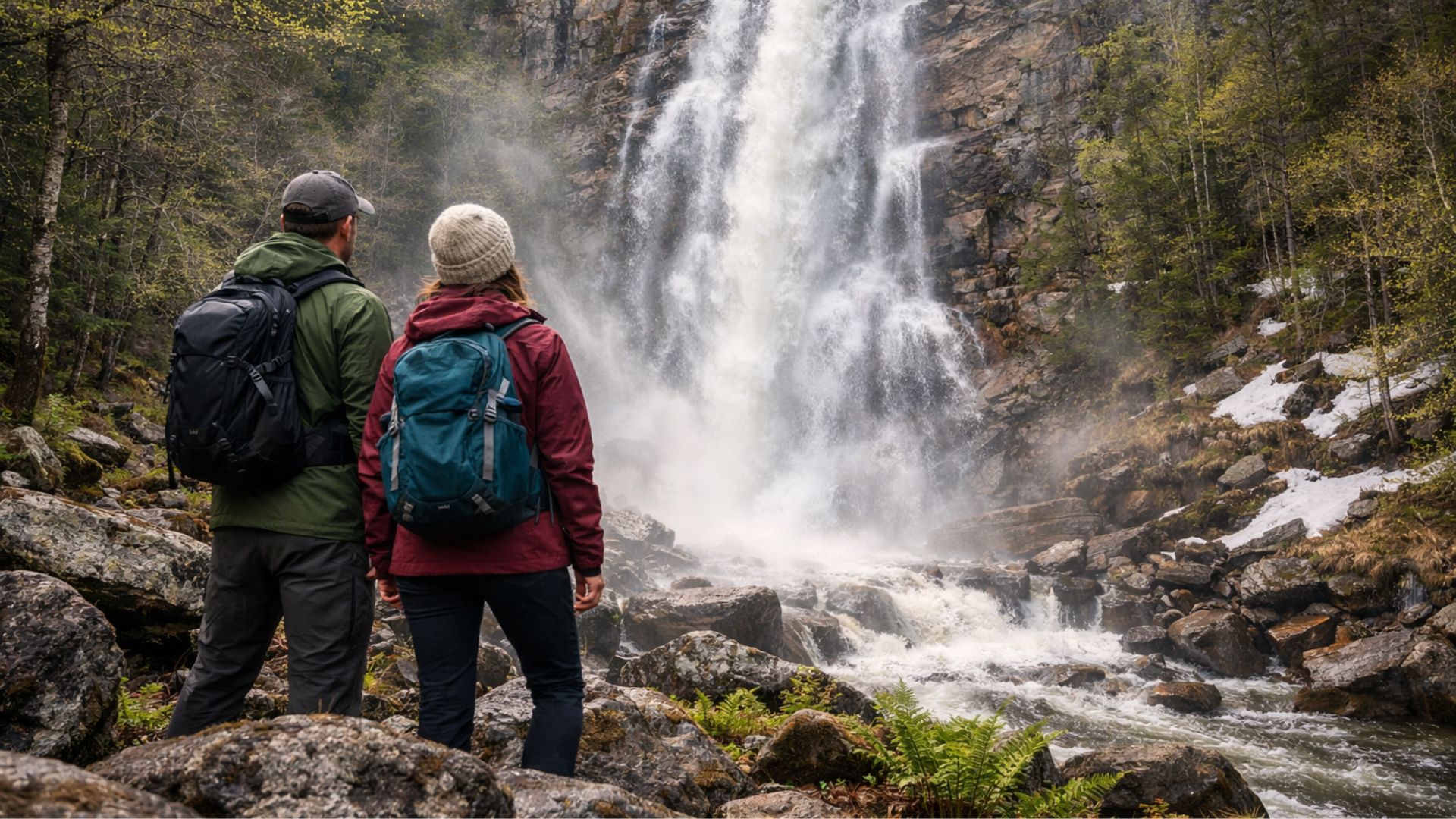
The first time you stand at the base of Arethusa Falls in late April, you understand immediately why hikers who visit in spring come back for it every year.
The water does not fall. It thunders. The mist hits you before you even see the main drop. The sound is physical. And standing at the base of a 140-160 foot waterfall running at near-maximum volume is one of those outdoor experiences that genuinely resets your sense of scale.
This is what snowmelt does to the White Mountains. The Presidential Range receives over 23 feet of total annual snowfall, with the accumulated snowpack at higher elevations melting over six to eight weeks in spring. Every waterfall in the region runs at a volume and force in April and May that it simply will not reach again until the following spring. At peak spring flow, waterfalls spread dramatically wider across the granite faces than the summer trickle, creating walls of white water. The difference in what you experience on the trail is even bigger than the visual suggests.
We have been managing vacation rentals in the White Mountains since 2017 and have watched the spring waterfall season from the front row every year. The Bretton Woods and Crawford Notch corridor, which sits at the heart of our rental territory, has the highest concentration of accessible spring waterfalls in New Hampshire.
This guide covers the seven we recommend most to hikers and outdoor enthusiasts, with everything you need to plan your visit, hit the optimal timing window, and get the most out of each trail.
Spring waterfalls in the White Mountains reach peak flow from mid-April through late May, driven by snowmelt from the Presidential Range and surrounding ridgelines. Arethusa Falls (approximately 140-160 feet, NH’s tallest) runs at dramatically higher volume during peak spring flow compared to late summer. Lower-elevation falls, including Silver Cascade and Ripley Falls, typically peak in mid-April. Higher-elevation falls, including Cloudland Falls, peak from late April through mid-May. The optimal window for catching the most waterfalls simultaneously at peak flow is late April through the first week of May.
WHY SPRING IS PEAK WATERFALL SEASON IN THE WHITE MOUNTAINS
The trail conditions and visitor experience in the White Mountains change dramatically from season to season. Most hikers visit in summer or fall, and both are excellent for different reasons. But neither is when the waterfalls are at their best, and that is a gap in most visitors’ White Mountains experience that spring closes completely.
When the Presidential Range and surrounding ridgelines begin to shed their winter snowpack, the water moves fast. It funnels through drainage gullies and streambeds that have been dormant since freeze-up, picking up volume with every mile it travels downhill. By the time that water reaches the lip of a waterfall, it is carrying a force that the same waterfall simply does not see in July or August.
The transformation is most visible at waterfalls that look modest in summer. Silver Cascade on Route 302, which appears as a relatively thin roadside cascade in late August, becomes a dramatic multi-strand wall of white water in late April. Ripley Falls, which is 100 feet tall year-round, sounds genuinely different in spring because the volume amplifies through the narrow granite slot canyon at its base.
For hikers who want to see the White Mountains at a moment most visitors miss entirely, spring waterfall season is the window.
Timing Your Visit for Maximum Flow
Getting the timing right matters. Here is how the spring waterfall season typically unfolds across the region:
| Timeframe | Conditions | Best Falls to Target |
| Early April | High-elevation falls are still frozen. Lower falls beginning to surge. | Silver Cascade, Flume Cascade, Ripley Falls |
| Mid-April | Lower-elevation falls at or near peak. Most approach trails are accessible. | All roadside falls, Arethusa Falls, Sabbaday Falls |
| Late April to Early May | Peak flow across the region. The optimal window for all 7 falls on this list. | All 7 falls |
| Mid-May | Flow remains strong. All trails are fully accessible. Flume Gorge opens. | Full list plus Flume Gorge |
| Late May | Flow diminishing but still impressive. Higher falls are still strong. | Cloudland Falls, Arethusa Falls, Sabbaday Falls |
The sweet spot for most hikers who want to experience the maximum number of falls simultaneously at or near peak flow is the last week of April through the first week of May.
Note on trail conditions: Early spring (late March through mid-April) means mud season on lower-elevation trails. Learn more about experiencing mud season in New England and what to expect during this unique transition period.
1. Arethusa Falls: New Hampshire’s Tallest Waterfall at Peak Power
No spring waterfall list for the Bretton Woods area starts anywhere else. Arethusa Falls, at approximately 140-160 feet, is the tallest waterfall in New Hampshire. In late April, running at peak spring volume, it is also one of the most powerful and visually dramatic outdoor experiences in all of New England.
The trailhead is off Route 302 in Hart’s Location, 10 to 15 minutes from most Bretton Woods vacation rentals. The hike runs 2.8 miles round trip with 900 feet of elevation gain. Most fit hikers complete it in 90 minutes to two hours at a solid pace, or two to three hours at a more relaxed one.
Spring-specific trail notes: The approach trail crosses several stream crossings that run full with snowmelt from late April onward. Waterproof boots are essential. You will also encounter snow bridges on the upper approach through late April. They are generally solid but worth treating carefully. Trekking poles improve stability on both the snow bridges and the wet approach trail.
At peak flow, the spray zone at the base of the falls extends 25 to 30 feet outward. You will get misted regardless of where you stand. A packable rain jacket in your pack is useful here, or you accept that a little waterfall mist is part of the experience.
Insider timing tip: visit on a warm day that follows two to three days of rain for maximum flow. Sustained rain combined with warm snowmelt temperatures produces the highest volume in the spring window.
Trail stats at a glance:
- Distance: 2.8 miles round trip
- Elevation gain: 900 feet
- Difficulty: Moderate
- Drive from Bretton Woods rentals: 10 to 15 minutes
- Gear needed in April: Waterproof boots, trekking poles, microspikes for the upper approach
- Peak flow window: Late April through mid-May
For more spring hiking options in the area, check out our guide to spring hikes in Bretton Woods with additional trail recommendations and seasonal tips.
2. Ripley Falls: 100 Feet of Spring Volume in an Easy Package
Ripley Falls sits on the opposite side of Route 302 from Arethusa, and it delivers a completely different waterfall experience on one of the most accessible trails in Crawford Notch.
The trail is 1.0 mile round trip with minimal elevation gain, which puts it in the easy category for almost any hiker. The falls drop 100 feet through a narrow granite slot canyon that does something interesting to the sound in spring: the confined space amplifies the water volume in a way that makes Ripley Falls sound bigger than its dimensions suggest. At peak flow, standing at the base feels like being inside the waterfall rather than next to it.
Because Ripley Falls sits at a lower elevation than some of the more demanding trails on this list, it tends to hit peak flow a bit earlier in April than higher-elevation falls like Cloudland Falls. It is often the first sign that spring waterfall season has genuinely arrived.
Trail stats at a glance:
- Distance: 1.0 mile round trip
- Elevation gain: Minimal
- Difficulty: Easy
- Drive from Bretton Woods rentals: 10 to 15 minutes
- Gear needed in April: Waterproof trail shoes are sufficient
- Peak flow window: Mid-April through early May
3. Silver Cascade: 250 Feet of Spring Power Without Leaving the Road
Silver Cascade is the falls for hikers who want to experience peak spring flow without spending time on a trail. The cascade drops 250 feet in a dramatic multi-strand configuration that is visible directly from the Route 302 roadside pull-off in Crawford Notch.
In late summer, Silver Cascade is a pleasant sight, a collection of thin white lines on a dark granite wall. In late April, the same granite wall is covered wall-to-wall in surging white water. The roadside view captures the full height and width of the cascade in a single frame, which makes it one of the best photography spots in the region during the spring season.
For hikers, Silver Cascade is a natural add-on to any Crawford Notch day. Stop here before or after the Arethusa Falls hike and spend 15 minutes with a camera at the pull-off. The combination of a demanding waterfall hike at Arethusa and the effortless roadside spectacle of Silver Cascade in the same afternoon covers both ends of the spring waterfall spectrum.
Quick stats:
- Hiking required: None
- Drive from Bretton Woods rentals: 15 to 20 minutes
- Best photography position: Roadside pull-off, slightly to the right of center, looking up at the full cascade face
- Peak flow window: Mid-April through late April
4. Flume Cascade: The Photographer’s Roadside Stop
Flume Cascade drops roughly 40 feet in a distinctive fan shape that photographers return to year after year. The falls are visible from a pull-off on Route 302, just half a mile south of Silver Cascade, making it straightforward to combine both in a single 30-minute stop.
In spring, the increased volume spreads the fan pattern wider and pushes the edge of the cascade further out from the granite face. The contrast between the white water and the dark wet granite on a grey April day is a clean, dramatic composition that rewards time spent with a camera and tripod.
For hikers building a spring waterfall day around the Crawford Notch corridor, pairing the Arethusa Falls trail with a late-afternoon roadside circuit of Flume Cascade and Silver Cascade on the drive back is a highly efficient use of the day.
Quick stats:
- Hiking required: None
- Drive from Bretton Woods rentals: 15 minutes
- Best photography window: Mid-morning to early afternoon for the best light angle on the falls face
- Peak flow window: Mid-April through late April
5. Cloudland Falls on the Falling Waters Trail: Three Waterfalls in One Hike
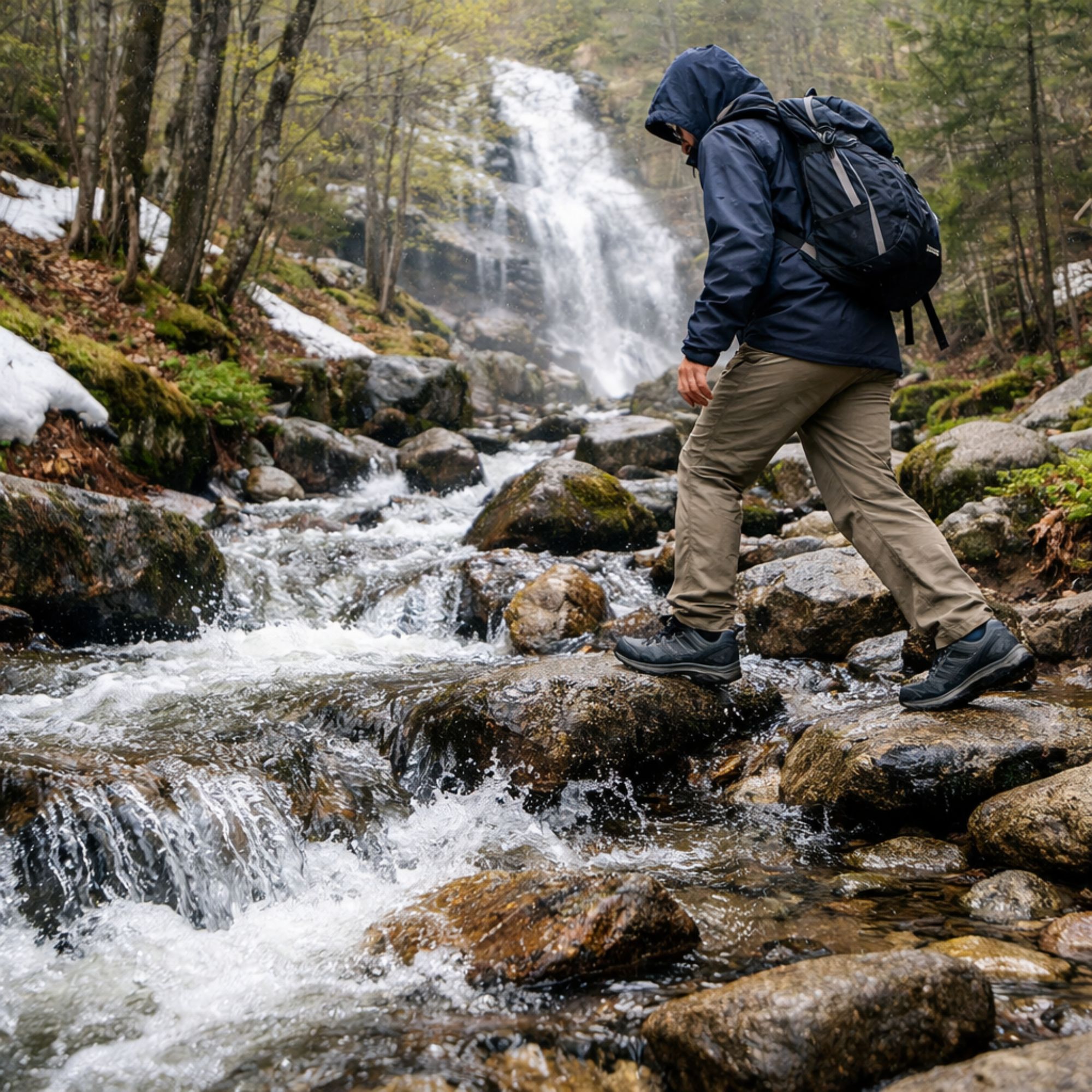
The Falling Waters Trail in Franconia Notch is the best single hike on this list for waterfall density. The trail passes three distinct waterfalls before reaching Cloudland Falls, the main destination, which means you get four distinct waterfall experiences in a single 3.2-mile round trip.
The sequence on the way up: Stairs Falls (a 20-foot cascade over wide granite shelves), Swiftwater Falls (40 feet over a broad, angled granite face), and then Cloudland Falls at 80 feet. Each is architecturally different from the others. In spring, all three run with a force that makes the trail feel like a completely different experience than it does in July.
At higher elevation, the Cloudland Falls area retains snow well into May. Microspikes are essential through mid-May on this trail. The approach to Cloudland Falls involves some rocky sections that become genuinely difficult without traction on wet snow.
Trail stats at a glance:
- Distance: 3.2 miles round trip
- Elevation gain: 1,000 feet
- Difficulty: Moderate to strenuous
- Drive from Bretton Woods rentals: 35 to 40 minutes
- Gear needed in April: Waterproof boots, microspikes, trekking poles
- Peak flow window: Late April through mid-May
For hikers who want to extend this trail further, the Falling Waters Trail continues to the Franconia Ridge Loop, one of the premier ridge hikes in the White Mountains. The upper sections of the ridge retain significant snow through May and require full winter hiking preparedness.
6. The Basin: A Glacial Pothole at Spring Volume
The Basin in Franconia Notch State Park is not a traditional waterfall, but it belongs on this list because of what spring does to it. The 25,000-year-old glacial pothole sits where the Pemigewasset River drops through a perfectly carved granite bowl, and at spring volume, the water churning through The Basin creates a sound and visual intensity that the same spot simply does not produce in summer.
The walk from the parking area is 0.2 miles on a flat, paved path, making The Basin one of the most accessible spring waterfall experiences in the White Mountains. For hikers doing a full Franconia Notch day, The Basin makes an ideal first or last stop before or after a more demanding trail. For anyone in your group who is not hiking that day, The Basin is genuinely worth the drive on its own—and there are plenty of other family-friendly activities in the White Mountains nearby.
Quick stats:
- Hiking required: 0.2 miles on flat paved trail from parking
- Accessibility: Fully accessible for all mobility levels
- Drive from Bretton Woods rentals: 30 to 35 minutes
- Peak flow window: Mid-April through mid-May
7. Sabbaday Falls: The Kancamagus Gem
Sabbaday Falls sits on the Kancamagus Highway and rewards the low-effort trail with waterfall architecture that is unlike anything else on this list. The falls drop 45 feet through a series of three distinct stages: a narrow upper flume, a mid-level plunge pool, and a wide lower spread at the base.
In spring, the narrow upper flume section amplifies the water in the same way that Ripley Falls does, creating a sound that is significantly larger than the trail distance prepares you for. The approach boardwalk is typically reopened by late April after winter closure, and the 0.6-mile round trip makes Sabbaday a quick, high-return stop on any Kancamagus Highway drive.
For hikers building a full spring waterfall day that combines Crawford Notch and the Kancamagus, adding Sabbaday Falls to the afternoon portion of the route takes roughly an hour from the parking area and back and adds a meaningfully different waterfall character to the day.
Trail stats at a glance:
- Distance: 0.6 miles round trip
- Elevation gain: Minimal
- Difficulty: Easy
- Drive from Bretton Woods rentals: 40 to 50 minutes via Kancamagus Highway
- Peak flow window: Late April through mid-May
PLANNING YOUR SPRING WATERFALL DAY FROM A BRETTON WOODS RENTAL
The Bretton Woods corridor is the best home base for a spring waterfall day in the White Mountains because of its central position relative to both Crawford Notch (to the south and east) and Franconia Notch (to the west). From most of our rental properties, you can reach the Arethusa Falls trailhead in 10 to 15 minutes and the Franconia Notch State Park entrances in 30 to 40 minutes.
A suggested one-day waterfall route for hikers based near Bretton Woods:
Morning: Arethusa Falls trail (allow 2.5 to 3 hours)
Midday: Ripley Falls trail and roadside stops at Silver Cascade and Flume Cascade on Route 302 (allow 90 minutes)
Afternoon: Drive the Kancamagus Highway east, stopping at Sabbaday Falls (allow 2 to 2.5 hours including drive)
This circuit covers five of the seven falls on this list in a single day and works well for hikers with a moderate fitness level. The Kancamagus Highway drive is scenic in its own right—explore more breathtaking road trips in New Hampshire for additional routes worth exploring during your visit. For international travelers planning waterfall hikes and scenic drives across the region, using international phone plans like Holafly can make it easier to stay connected for navigation, trail updates, and travel coordination without relying on expensive roaming fees. Adding Franconia Notch (The Basin and Falling Waters Trail) requires a separate day, which is easily done from a multi-night Bretton Woods rental.
Spring gear checklist for White Mountains waterfall hiking:
- Waterproof hiking boots (stream crossings are frequent and unavoidable on approach trails)
- Rain jacket (falls mist is guaranteed at most of these locations at spring volume)
- Microspikes (essential above 2,500 feet through mid-May)
- Trekking poles (useful on wet approach trails and snow bridges)
- Camera with weather protection or a waterproof housing
- Packable dry bag for electronics in the falls spray zone
- Bear canister or hang system if bringing food (black bears are active in the White Mountains in spring)
Looking for more ways to enjoy the mountains in spring? Our guide to family-friendly spring activities in NH covers everything from maple sugaring to wildlife viewing. And if you’re bringing your dog along, explore our pet-friendly hiking trails near Bretton Woods for waterfall adventures with your furry companion.
SPRING WATERFALLS FAQ
When is the best time to see waterfalls in the White Mountains?
The best time to see White Mountains waterfalls at peak flow is late April through the first week of May. This window catches the maximum snowmelt volume from the Presidential Range and surrounding peaks. Lower-elevation falls like Silver Cascade and Ripley Falls peak in mid-April. Higher-elevation falls like Cloudland Falls on the Falling Waters Trail reach peak flow from late April through mid-May. Flow remains impressive through late May, though it diminishes noticeably by early June.
Are White Mountain waterfall trails open in April?
Most lower-elevation waterfall trails in the White Mountains are open in April, though some approach trails have wet or muddy sections and stream crossings that require waterproof footwear. Trails above 3,000 feet typically retain snow and ice through mid-May and require microspikes. The boardwalk at Sabbaday Falls typically reopens by late April after winter closure. Always check current trail conditions through the AMC White Mountain trail report before heading out.
What gear do I need for spring waterfall hikes in the White Mountains?
For spring waterfall hikes near Bretton Woods, pack waterproof hiking boots, a rain jacket, microspikes for any trail above 2,500 feet, and trekking poles for stream crossings and snow bridges. Most waterfalls on this list produce significant mist at peak spring flow, so waterproof or water-resistant gear for electronics is worth bringing. Bear spray or a bear canister is advisable, as black bears are active in the White Mountains starting in April.
Which White Mountain waterfalls can you see without hiking?
Silver Cascade and Flume Cascade on Route 302 in Crawford Notch are both visible from roadside pull-offs with no hiking required. The Basin in Franconia Notch State Park is accessible via a 0.2-mile flat paved path from the parking area and is fully accessible for all mobility levels. These three locations are ideal for groups with members who prefer not to hike while still experiencing peak spring waterfall flow.
How do I plan a full spring waterfall day near Bretton Woods?
A strong one-day waterfall circuit from Bretton Woods starts with the Arethusa Falls trail in the morning (2.5 to 3 hours), followed by Ripley Falls and the Route 302 roadside stops at Silver Cascade and Flume Cascade at midday (90 minutes), and finishes with a Kancamagus Highway drive to Sabbaday Falls in the afternoon (2 hours including the drive). This covers five of the seven falls on this list in a single day at a moderate pace.
STAY CLOSE TO THE ACTION WITH BRETTON WOODS VACATIONS
Spring waterfall season fills up faster than most first-time visitors expect. The late April through early May window is the most popular booking window in our spring rental calendar, driven by hikers and outdoor enthusiasts who know exactly what that timing offers.
Our 125+ curated vacation rentals across the White Mountains put you within 10 to 40 minutes of every waterfall on this list. We have properties with hot tubs for the evenings after full hiking days and homes with gear storage and mudrooms for wet boots and damp gear, and our guest services team is available 24 hours a day with current trail conditions, restaurant recommendations, and everything else you need to make the most of your spring mountain adventure.
Not sure which rental is right for your group? Read our comparison of vacation rentals vs. hotels in Bretton Woods to understand the advantages of a full home rental for waterfall-focused trips.
Browse our spring rental availability or get in touch with our local team directly. We live here. We hike these trails. We will help you plan a spring waterfall trip worth repeating every year.